

Is car insurance mandatory in Ontario? What the law requires
By Dave De Vries · Updated 2026-06-16

Ontario is one of the Canadian provinces where auto insurance is not optional. If you own or operate a vehicle on a public road, provincial law requires you to carry a minimum level of coverage before you turn the key, and driving without it carries real legal and financial consequences.
This is general legal information, not legal advice. Requirements can change and specific situations vary, so confirm current rules with a licensed broker or Ontario’s Financial Services Regulatory Authority before you make a coverage decision.
What the law actually requires
Every vehicle registered and driven in Ontario needs, at minimum, a policy that includes:
- Third-party liability coverage, which pays for injury or property damage you cause to someone else.
- Statutory accident benefits, which cover medical and rehabilitation costs for you and your passengers regardless of who was at fault.
- Uninsured motorist coverage, which protects you if you are hit by a driver who has no insurance or flees the scene.
Collision coverage, which pays to repair your own vehicle after an at-fault accident, and comprehensive coverage, which covers theft, vandalism, and non-collision damage, are not required by provincial law. In practice, most lenders and leasing companies require both for financed or leased vehicles, so the “optional” coverage becomes a practical requirement for a large share of drivers.
Why the requirement exists
The mandatory minimums exist to make sure that anyone hurt or whose property is damaged in a collision has a path to compensation, and that the medical costs of a crash do not fall entirely on the public health system or the individuals involved. Ontario’s accident benefits structure in particular is designed to get injured people access to treatment quickly, independent of who is found at fault.
What happens if you skip it
| Consequence | What it looks like |
|---|---|
| Provincial fine | A substantial penalty for a first offence, higher for repeat offences |
| Licence suspension | Possible suspension of your driving privileges |
| Vehicle impoundment | Your vehicle can be impounded at your own expense |
| Personal liability | You remain personally responsible for any damage or injury you cause |
| Future coverage cost | Insurers treat a lapse or conviction as a significant risk factor going forward |
Beyond the legal penalties, driving without insurance means any damage or injury you cause comes out of your own pocket, with no policy to absorb the cost. For most drivers, that risk alone outweighs any short-term savings from skipping coverage.
Keeping your coverage valid
A policy only protects you if it is active and accurately describes how you use your vehicle. Common ways drivers accidentally put their coverage at risk include letting a policy lapse between insurers, not updating the insurer when a vehicle’s primary driver changes, or using a personal policy for regular commercial use like rideshare driving without adding the right endorsement. If your situation has changed since you last renewed, it is worth a quick call to your auto insurance broker to confirm your policy still matches how you actually drive.
Proof of insurance, and why you need to carry it
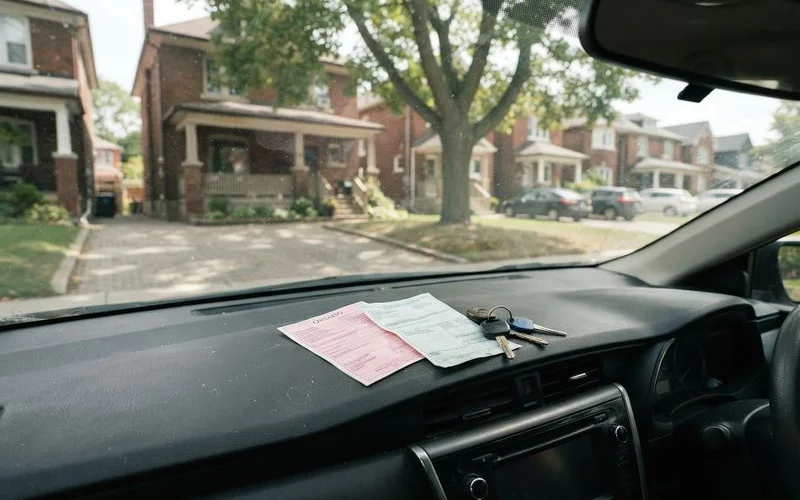
Ontario law also requires drivers to carry proof of insurance, commonly known as a pink card, whenever they’re operating a vehicle, and to produce it if stopped by police or involved in a collision. Many insurers now offer a digital version alongside the physical card, but either way, the requirement is the same: proof needs to be current and readily available, not something you have to track down after the fact.
Using your vehicle for rideshare or delivery work
A personal auto policy is written around personal use, and regularly using your vehicle for rideshare driving or paid delivery work typically falls outside that scope unless you’ve added a specific endorsement or purchased a commercial policy. Driving for one of these platforms without the right coverage can leave you without protection exactly when you’d expect it, since the insurer may treat the claim as outside your policy’s terms. If this describes how you use your vehicle, it’s worth a direct conversation with your broker before an incident forces the question.
If your record makes standard coverage hard to find
Drivers with a serious violation, multiple claims, or a recent cancellation sometimes find standard insurers unwilling to offer a policy. Ontario maintains a risk-sharing mechanism for exactly this situation, so coverage remains available even for higher-risk drivers, typically at a higher premium. A broker can walk you through what that looks like if a standard policy isn’t currently an option.
For more on how providers in this directory are evaluated, see our ranking methodology, or return to the homepage to browse the full range of coverage types available in the Toronto area.
FAQ
- What is the minimum car insurance required by law in Ontario?
- Ontario requires at least third-party liability coverage, along with statutory accident benefits and uninsured motorist coverage, as part of every standard auto policy. Collision and comprehensive coverage are not legally required, though a lender will usually require them if you have a car loan or lease.
- What happens if I get caught driving without insurance in Ontario?
- Driving uninsured is a provincial offence that can carry a substantial fine, a possible licence suspension, and a vehicle impoundment, on top of leaving you personally responsible for any damage or injury you cause. It also makes future coverage significantly harder and more expensive to obtain.
- Do I need insurance if I only drive occasionally?
- Yes. The requirement applies to anyone who owns or regularly operates a vehicle in Ontario, not just daily drivers. If you drive rarely, ask a broker about lower-mileage or occasional-driver policies rather than skipping coverage altogether.
- Does Ontario insurance cover me if I drive in another province or the US?
- A standard Ontario policy generally extends coverage when you drive elsewhere in Canada or the United States, though the specific limits can differ. Confirm the details with your broker before a long trip, especially cross-border.
Related on this site
- Browse auto insurance providers
- Best auto insurance in Toronto, Ontario →
- What car insurance costs in Ontario and what changes your rate
- How an at-fault accident affects your car insurance rates in Ontario
- How to switch car insurance providers in Ontario without a coverage gap
- Car insurance for new drivers and newcomers to Ontario
- All guides →